
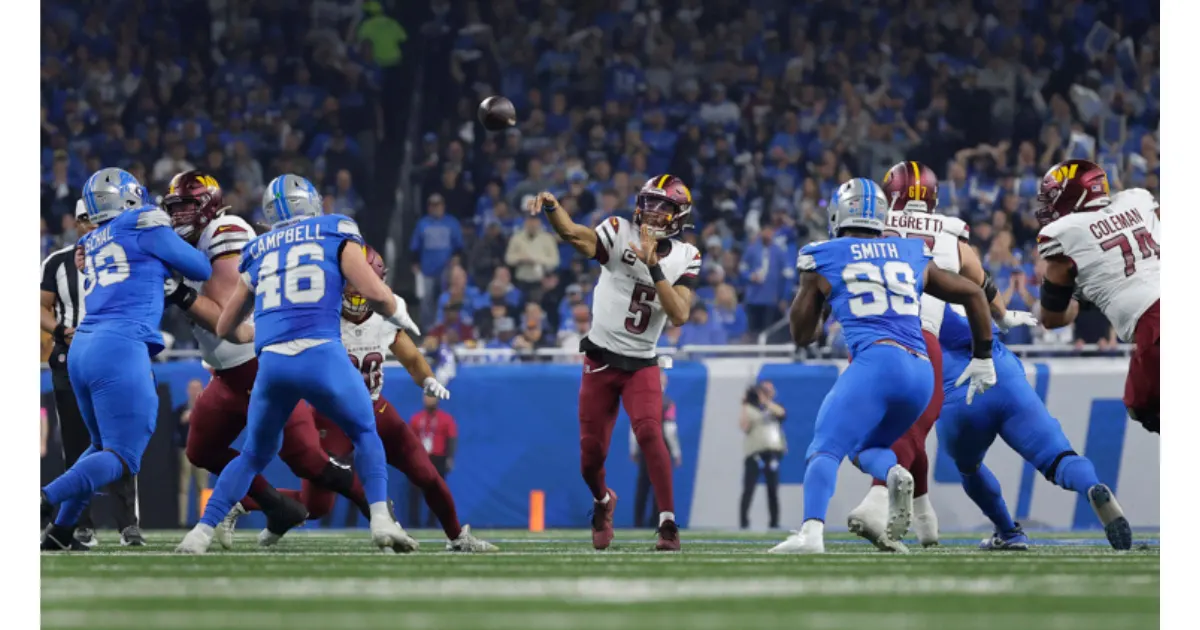

On January 18, 2025, the Washington Commanders pulled off one of the most stunning upsets in recent NFL playoff history, defeating the top-seeded Detroit Lions 45-31 in the NFC Divisional Round at Ford Field. Led by rookie quarterback Jayden Daniels, the Commanders showcased a dynamic offense, a relentless defense, and a fearless approach that propelled them to their first NFC Championship appearance since 1991. This article dives deep into the player stats, key performances, and pivotal moments from this unforgettable game, breaking it all down in a way that’s easy to understand for fans of all ages. Whether you’re a die-hard football fan or just curious about the numbers behind this epic clash, we’ve got you covered with a comprehensive, SEO-friendly analysis.
Game Overview: A High-Scoring Shootout
The Washington Commanders, a No. 6 seed with a 14-5 record, entered the game as nearly double-digit underdogs against the Detroit Lions, who boasted a franchise-record 15-3 season and the NFC’s top seed. Despite the odds, Washington’s balanced attack and opportunistic defense overwhelmed Detroit, capitalizing on five turnovers to secure a decisive victory. The game was a high-scoring affair, with the second quarter alone setting an NFL playoff record for points scored in a single quarter (42 combined points). Let’s break down the stats and highlight the players who made this game a classic.
Washington Commanders: Key Player Stats
Jayden Daniels (Quarterback)
Rookie quarterback Jayden Daniels was the star of the show, delivering a performance that solidified his status as a rising NFL superstar. Daniels completed 22 of 31 passes for 299 yards, throwing two touchdowns with zero interceptions, earning a stellar 122.9 passer rating. He also added 51 rushing yards on the ground, totaling 350 combined yards, which ranks second all-time among rookie quarterbacks in a postseason game. His poise under pressure was remarkable, especially against Detroit’s aggressive blitz. According to NextGenStats, Daniels went 12-for-16 for 191 yards and a touchdown against the blitz, showcasing his ability to handle high-pressure situations.
-
Passing: 22/31, 299 yards, 2 TDs, 0 INTs, 122.9 passer rating
-
Rushing: 51 yards
-
Notable Plays: A 58-yard touchdown pass to Terry McLaurin and a 5-yard touchdown pass to Zach Ertz
-
Historical Context: Daniels set a rookie record with 242 passing yards in the first half and became only the second rookie QB to defeat a No. 1 seed in the playoffs, joining Joe Flacco (2009).
Daniels’ ability to avoid turnovers while making big plays was a game-changer, keeping Washington’s offense on track and exploiting Detroit’s injury-riddled defense.
Brian Robinson Jr. (Running Back)
Running back Brian Robinson Jr. bounced back from a lackluster Wild Card performance, leading the Commanders’ ground game with 77 yards on 15 carries (5.1 yards per attempt) and two rushing touchdowns. His 73.3% rushing success rate was the second-highest in the Divisional Round among players with at least five carries. Robinson’s early 14-yard run set the tone for Washington’s first scoring drive, and his two short touchdown runs (2 yards and 1 yard) were critical in maintaining the lead.
-
Rushing: 15 carries, 77 yards, 2 TDs, 5.1 yards per attempt
-
Key Stat: All 77 yards were gained before contact, a stark contrast to his Wild Card game where most yards came after contact.
Robinson’s resurgence was a key factor in Washington’s balanced attack, which racked up 182 rushing yards against a Lions defense missing several key players.
Terry McLaurin (Wide Receiver)
Wide receiver Terry McLaurin made a massive impact with a 58-yard touchdown catch-and-run on a screen pass, turning a short throw into a game-changing score. He finished with 4 receptions on 6 targets for 87 yards, including 81 yards after the catch. His ability to break tackles and gain big yards after short passes was pivotal in stretching Detroit’s defense.
-
Receiving: 4/6, 87 yards, 1 TD
-
Key Stat: 60 of his 87 yards came on the touchdown reception, showcasing his big-play ability.
Dyami Brown (Wide Receiver)
Dyami Brown led Washington’s receivers with 6 catches on 8 targets for 98 yards and three first downs. His 3.5 yards per route run was elite, and he averaged 5.2 yards after the catch per reception. Brown’s performance in the postseason has been remarkable, with 187 receiving yards, the most among active players at the time.
-
Receiving: 6/8, 98 yards, 3 first downs
-
Key Stat: 12.3 average depth of target (ADOT), showing his role in stretching the field.
Austin Ekeler and Jeremy McNichols (Running Backs)
Austin Ekeler contributed 47 yards on 6 carries, with 35 yards coming on a single fourth-quarter run that set up a touchdown. Jeremy McNichols added a 1-yard touchdown run that extended Washington’s lead to 45-28, effectively sealing the game.
-
Ekeler: 6 carries, 47 yards
-
McNichols: 1 TD (1-yard run)
Washington Defense: Turnover Machine
The Commanders’ defense was the unsung hero, forcing five turnovers that directly led to 17 points. Key performers included:
-
Mike Sainristil (Rookie Cornerback): Two interceptions, including one on a trick play by Lions receiver Jameson Williams. His second pick in the fourth quarter was a dagger, setting up McNichols’ touchdown.
-
Quan Martin (Safety): A 40-yard pick-six off a Jared Goff overthrow, giving Washington a 10-point lead in the second quarter.
-
Dorance Armstrong and Frankie Luvu: Armstrong’s strip-sack on Goff, recovered by Luvu, led to a 78-yard scoring drive.
-
Jeremy Chinn: Sealed the game with an interception in the end zone.
The defense’s ability to capitalize on Detroit’s mistakes was crucial, as they held the Lions to just one punt but turned turnovers into points. Washington’s 481 total yards (299 passing, 182 rushing) and 3-for-4 fourth-down conversions underscored their dominance.
Detroit Lions: Key Player Stats
Jared Goff (Quarterback)
Lions quarterback Jared Goff had a night to forget, turning the ball over four times (three interceptions and one fumble). He completed 23 of 40 passes for 313 yards and one touchdown, but his 59.7 passer rating reflected the costly mistakes. Goff’s struggles against Washington’s blitz-heavy defense (31.5% blitz rate, fifth in the NFL) were evident, as he threw a pick-six, a fumble in scoring range, and an end-zone interception.
-
Passing: 23/40, 313 yards, 1 TD, 3 INTs, 59.7 passer rating
-
Notable Plays: A touchdown pass to Sam LaPorta gave Detroit a brief 14-10 lead, but his turnovers shifted momentum.
-
Key Stat: Four turnovers in the first half, including a pick-six to Quan Martin.
Jahmyr Gibbs (Running Back)
Running back Jahmyr Gibbs was a bright spot for Detroit, rushing for 105 yards on 14 carries (7.5 yards per attempt) and scoring two touchdowns. His 8-yard touchdown run in the third quarter briefly cut Washington’s lead to 31-28, but the Lions’ defense couldn’t hold.
-
Rushing: 14 carries, 105 yards, 2 TDs
-
Key Stat: Averaged 11 yards per carry in the first half, dominating early.
Amon-Ra St. Brown (Wide Receiver)
Wide receiver Amon-Ra St. Brown led Detroit’s passing game with 8 receptions for 137 yards. His 13-yard catch in the fourth quarter set up a field goal, but it wasn’t enough to overcome the deficit.
-
Receiving: 8 receptions, 137 yards
-
Key Stat: 19 first downs via passes, showing his role as Goff’s primary target.
Sam LaPorta (Tight End)
Tight end Sam LaPorta made a highlight-reel one-handed touchdown catch in the second quarter, giving Detroit a temporary lead. He finished with limited stats due to Washington’s defensive pressure on Goff.
-
Receiving: 1 TD (stats not fully detailed in sources)
Detroit Defense: Struggles with Injuries
The Lions’ defense was hampered by injuries, with cornerback Amik Robertson suffering a broken arm on Washington’s second snap and 13 defensive players already on injured reserve. They allowed 481 total yards and failed to force a single turnover, while Washington converted 3 of 4 fourth-down attempts. The defense’s inability to stop Daniels and the Commanders’ run game was a deciding factor.
Team Washington Commanders vs Detroit Lions Match Player Stats Comparison
Here’s a side-by-side look at the team stats:
|
Category |
Washington Commanders |
Detroit Lions |
|---|---|---|
|
Total Yards |
481 | 521 |
|
Passing Yards |
299 | 320 |
|
Rushing Yards |
182 | 201 |
|
First Downs |
27 | 30 |
|
Turnovers |
0 | 5 |
|
Fourth-Down Conversions |
3/4 |
N/A |
|
Time of Possession |
33:59 | 26:01 |
|
Points Scored |
45 | 31 |
Washington’s efficiency on fourth downs and zero turnovers were critical in maintaining control, despite Detroit’s slight edge in total yards.
Key Moments That Defined the Game
-
Second-Quarter Explosion: The teams combined for 42 points in the second quarter, the highest-scoring quarter in NFL playoff history. Washington’s 28 points, including McLaurin’s 58-yard touchdown and Martin’s pick-six, gave them a 31-21 halftime lead.
-
Turnover Frenzy: Detroit’s five turnovers (four by Goff, one by Williams) directly led to 17 points for Washington, including a 78-yard drive after a strip-sack and a 66-yard score after Sainristil’s interception.
-
Fourth-Down Gambles: Coach Dan Quinn’s aggressive play-calling paid off, with Washington converting 3 of 4 fourth-down attempts, including a critical 4th-and-2 at Detroit’s 13-yard line that led to McNichols’ touchdown.
-
Daniels’ Record-Breaking Half: Daniels’ 242 passing yards in the first half set a rookie playoff record, showcasing his ability to dominate early and set the tone.
Why Washington Won
The Commanders’ victory was a masterclass in capitalizing on opportunities. Daniels’ flawless performance (no turnovers, 350 total yards) kept the offense humming, while the defense’s five takeaways disrupted Detroit’s rhythm. Coach Dan Quinn’s aggressive strategy, particularly on fourth downs, kept the Lions’ defense on its heels. Washington’s balanced attack (182 rushing yards, 299 passing yards) exploited Detroit’s injury-weakened defense, and their belief in each other—highlighted by Quinn’s leadership—was evident in their relentless execution.
Why Detroit Lost
The Lions’ downfall came down to turnovers and defensive struggles. Goff’s four first-half turnovers, including a pick-six and a fumble in scoring range, dug a hole too deep to climb out of. The defense, missing key players like Amik Robertson, couldn’t stop Washington’s big plays or force turnovers. Despite a strong offensive output (521 yards), the Lions’ five turnovers and inability to sustain defensive stops ended their Super Bowl hopes.
Washington Commanders vs Detroit Lions Match Player Stats Historical Context
Washington’s win marked their first NFC Championship appearance since 1991, a remarkable turnaround for a team that went 4-13 the previous season. Daniels joined Joe Flacco as the only rookie quarterbacks to defeat a No. 1 seed in the playoffs. For Detroit, the loss was a crushing blow, making them only the second team in NFL history (alongside the 2011 Packers) to win 15 regular-season games and fail to win a playoff game.
What’s Next Washington Commanders vs Detroit Lions Match Player Stats?
The Commanders advanced to face either the Philadelphia Eagles or Los Angeles Rams in the NFC Championship on January 26, 2025. With Daniels leading the charge and a defense peaking at the right time, Washington is one win away from a historic Super Bowl appearance. For the Lions, the offseason will focus on addressing defensive injuries and improving ball security to avoid another one-and-done playoff run.
Conclusion
The Washington Commanders vs Detroit Lions Match Player Stats was a showcase of grit, talent, and strategic brilliance. Jayden Daniels’ historic performance, paired with a turnover-hungry defense and a resurgent running game, made this game a defining moment in Washington’s storybook 2024 season. For fans looking to relive the stats and key plays, this game was a testament to the power of belief and execution under pressure. Stay tuned for more NFL playoff action as the Commanders chase their first Super Bowl in over three decades!