

Check cashing companies have become a go-to solution for many people who need quick access to cash without the hassle of traditional banking. Whether it’s a paycheck, a government check, or a personal check, these businesses offer a convenient way to turn paper into cash. But with their popularity comes a lot of myths and misconceptions. If you’ve ever wondered, “Which of the Following Statements About Check Cashing Companies Is False?” you’re not alone. Let’s dive into this topic in a simple, easy-to-read way to clear up the confusion and help you understand how these companies work.
In this article, we’ll explore what check cashing companies are, how they operate, and the common statements people make about them. We’ll also identify which of those statements are true and which one is false, all while keeping things clear for readers of any age. Plus, we’ll include a handy table summarizing the key points for quick reference. By the end, you’ll have a solid understanding of check cashing companies and be able to separate fact from fiction.
What Are Check Cashing Companies?
Before we get into the statements, let’s start with the basics. Check cashing companies are businesses that provide immediate cash for checks without requiring you to deposit them into a bank account. These companies are often found in strip malls, convenience stores, or standalone locations, and they cater to people who need quick cash or don’t have access to traditional banking services.
Here’s how it works: you bring in a check—whether it’s your paycheck, a tax refund, or a personal check—and the company verifies it. Once verified, they give you the cash, minus a fee for their service. The fees vary but are typically a percentage of the check’s value or a flat rate. For example, a $500 check might come with a 2% fee, meaning you’d pay $10 to get $490 in cash.
Check cashing companies are popular because they’re fast, don’t require a bank account, and often have longer hours than banks. But there’s a lot of misinformation out there about them, so let’s look at some common statements and figure out which one is false.
Common Statements About Check Cashing Companies
To answer the question, “Which of the following statements about check cashing companies is false?” let’s examine five common claims you might hear. We’ll go through each one, explain whether it’s true or false, and then summarize everything in a table for clarity.
Statement 1: Check Cashing Companies Charge High Fees
This statement is true. Check cashing companies do charge fees, and they can sometimes be higher than what you’d expect from a bank. Fees typically range from 1% to 5% of the check’s value, though some companies may charge more for certain types of checks, like personal or out-of-state checks. For example, cashing a $1,000 paycheck with a 3% fee means you’re paying $30. Over time, these fees can add up, especially if you cash checks frequently. Banks, on the other hand, often cash checks for free if you have an account, but check cashing companies rely on these fees to operate.
Statement 2: You Need a Bank Account to Use Check Cashing Companies
This statement is false. One of the biggest advantages of check cashing companies is that you don’t need a bank account to use their services. This makes them a popular choice for people who are unbanked (those without bank accounts) or underbanked (those with limited access to banking services). According to the FDIC, about 5.4% of U.S. households were unbanked in 2021, and many of these people rely on check cashing companies to access their money. All you typically need is a valid ID, like a driver’s license or passport, and the check itself. This accessibility is a key reason why these businesses thrive.
Statement 3: Check Cashing Companies Only Cash Paychecks
This statement is false, but let’s explore it further because it’s a common misconception. While check cashing companies are well-known for cashing paychecks, most of them handle a wide variety of checks. These can include:
-
Government checks: Social Security, tax refunds, or unemployment benefits.
-
Personal checks: Checks written by individuals, though these may have stricter verification processes.
-
Insurance checks: Payments from insurance companies.
-
Money orders: Prepaid checks that are often cashed for a small fee.
However, not every check cashing company accepts every type of check, and some may have limits on the check’s value or require extra verification. So, while they don’t only cash paychecks, there are some restrictions depending on the company.
Statement 4: Check Cashing Companies Are Regulated
This statement is true. Check cashing companies are subject to state and federal regulations to protect consumers. In the U.S., these businesses must comply with laws like the Bank Secrecy Act, which requires them to verify customer identities and report suspicious transactions. Many states also have specific licensing requirements and caps on the fees check cashing companies can charge. For example, California limits fees to 3% for most checks, while other states may allow higher rates. These regulations help ensure that customers aren’t taken advantage of, though the level of oversight varies by state.
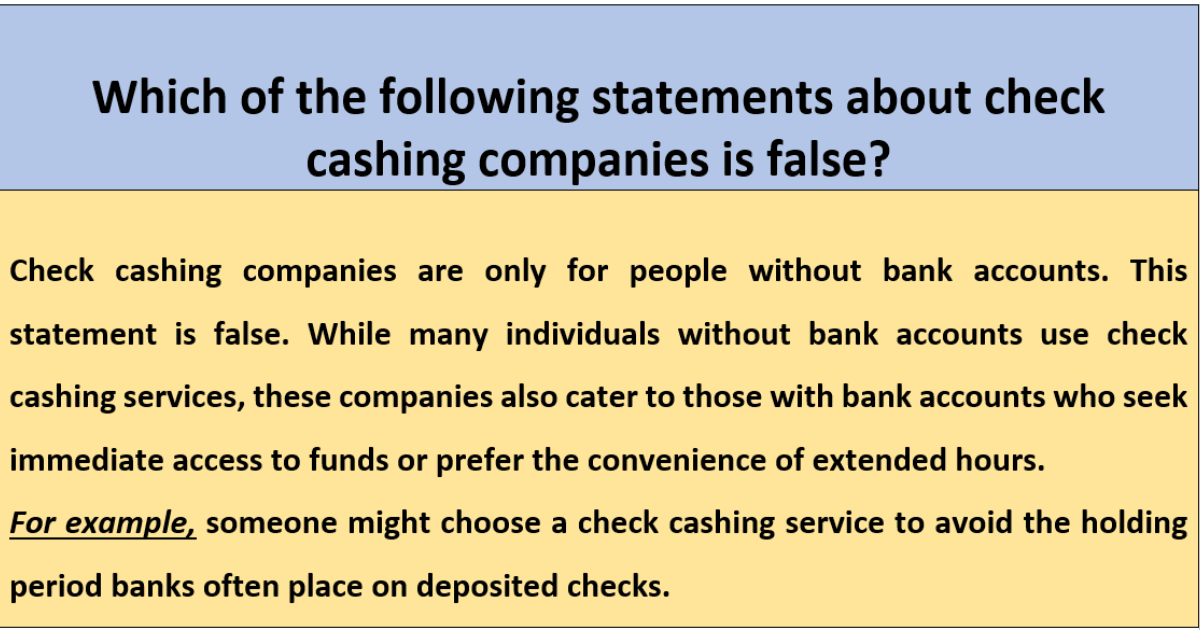
Statement 5: Check Cashing Companies Are Only for People Without Bank Accounts
This statement is false, but it’s a common belief. While check cashing companies are a lifeline for the unbanked, they’re also used by people who have bank accounts but prefer the convenience or speed of these services. For example, someone might use a check cashing company if:
-
They need cash immediately and can’t wait for a bank to clear the check.
-
Their bank is closed, but the check cashing company is open late.
-
They don’t trust banks or prefer dealing in cash.
In fact, a 2019 survey by the Federal Reserve found that 16% of people who used check cashing services had bank accounts, showing that these businesses serve a broader audience than you might think.
Which Statement Is False?
Based on our analysis, the false statements are:
-
Statement 2: You don’t need a bank account to use check cashing companies.
-
Statement 3: Check cashing companies don’t only cash paychecks; they handle various types of checks.
-
Statement 5: These companies aren’t just for people without bank accounts; many people with accounts use them too.
However, if we’re picking the most commonly misunderstood statement, Statement 2 (“You need a bank account to use check cashing companies”) is the one that’s most clearly false. This misconception often leads people to overlook check cashing companies as an option, assuming they’re ineligible without a bank account.
Why Do People Use Check Cashing Companies?
Now that we’ve cleared up the false statement, let’s explore why check cashing companies are so popular. Understanding their appeal can help you decide if they’re right for you.
-
Speed and Convenience: Check cashing companies often provide cash on the spot, unlike banks, which may place a hold on funds for several days. Many are open evenings and weekends, making them more accessible than traditional banks.
-
No Bank Account Required: As we’ve established, you don’t need a bank account, which is a huge plus for the unbanked or those who don’t trust banks.
-
Variety of Services: Beyond cashing checks, many companies offer additional services like money orders, bill payments, or prepaid debit cards, making them a one-stop shop for financial needs.
-
Accessibility: Check cashing companies are often located in areas where banks are scarce, such as low-income neighborhoods, providing a vital service for local residents.
However, there are downsides. The fees can be steep, and relying on check cashing companies long-term can be more expensive than maintaining a bank account. It’s worth weighing the pros and cons based on your financial situation.
Summary Table: True or False Statements About Check Cashing Companies
Here’s a quick reference table to summarize the statements we’ve discussed:
|
Statement |
True or False |
Explanation |
|---|---|---|
|
Check cashing companies charge high fees |
True |
Fees typically range from 1% to 5%, which can be costly over time. |
|
You need a bank account to use check cashing companies |
False |
No bank account is required; just a valid ID and the check. |
|
Check cashing companies only cash paychecks |
False |
They cash various checks, including government, personal, and insurance checks. |
|
Check cashing companies are regulated |
True |
They must follow state and federal laws, including licensing and fee caps. |
|
Check cashing companies are only for people without bank accounts |
False |
People with bank accounts also use them for convenience or speed. |
Conclusion
Check cashing companies play an important role in providing quick, accessible cash for people who need it, whether they have a bank account or not. While they come with fees and some limitations, they’re a valuable option for many. The false statement, “Which of the Following Statements About Check Cashing Companies Is False?” is a common myth that overlooks their accessibility. By understanding how these companies work and using them wisely, you can make informed decisions about your money.